Khobz —
the bread that is always there
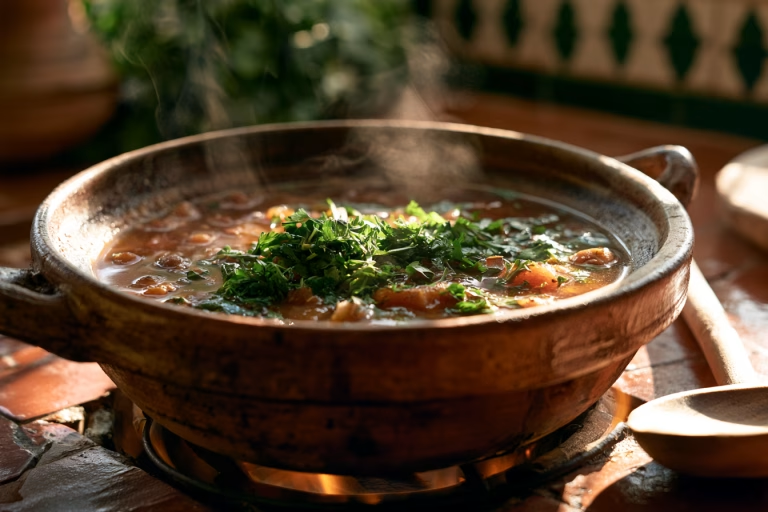
No Moroccan table is complete without it. No harira is eaten without it. No meal begins before it arrives.
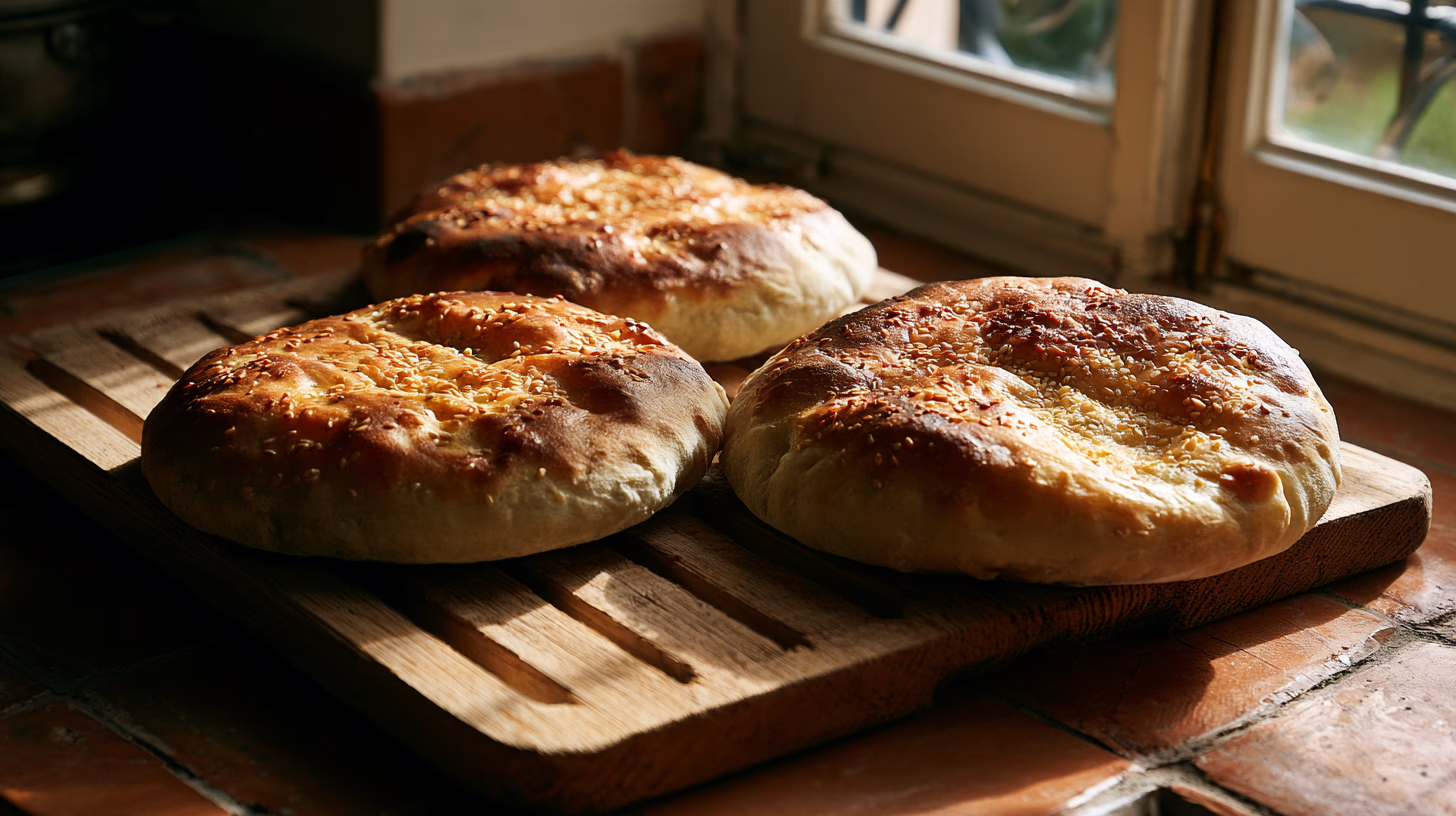
There is a word Moroccans use for bread that has no real equivalent in English: khobz. It refers to this specific bread — round, flat, golden — but it also means bread in the most fundamental sense. Not a type of bread. Bread itself. The thing without which a meal is not a meal.
Every morning in Morocco, women shape rounds of dough at home and send them — carried by children, balanced on wooden boards, wrapped in cloth — to the neighbourhood oven, the farran. The baker knows which loaf belongs to which family by the mark pressed into the dough: a thumbprint, a pattern, an initial scratched with a skewer. An hour later, the bread comes back. Warm. Crackling faintly at the crust. Already the best thing you will eat all day.
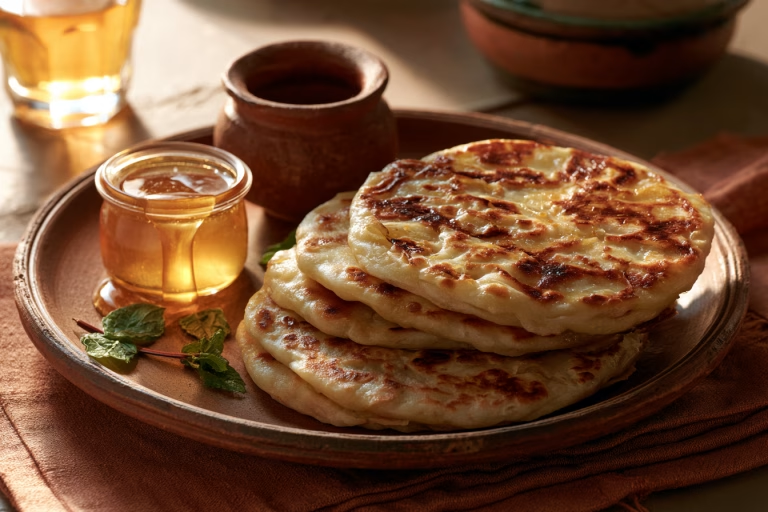
I ate khobz every single day in Morocco. With harira, with olive oil and preserved lemon, with argan oil poured into a small bowl still warm from the kitchen. Torn, not sliced. Shared, not portioned. Always at the centre of the table, never to the side of it.
This is how to make it at home.
The story
The neighbourhood oven and the family mark
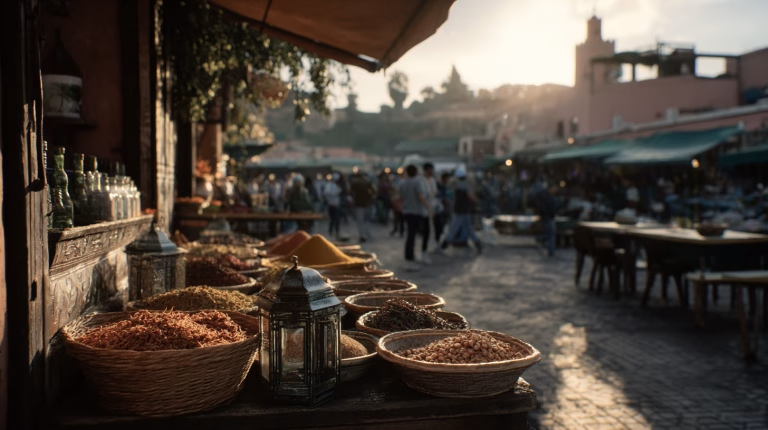
The farran — the communal wood-fired oven — is one of the oldest institutions in Moroccan urban life. It predates the arrival of domestic ovens by centuries, and in many medinas it is still in daily use. You find them tucked into the ground floors of old buildings, marked by nothing more than a thin plume of woodsmoke and a queue of people carrying trays.
The tradition works like this: you make your dough at home, shape it, mark it, and bring it to the farran. The baker slides it into the oven on a long wooden paddle and returns it to you when it is done. You pay a few dirhams. You carry it home still warm. You have been doing this, or your mother has, or her mother did, for generations.
“The bread is not baked at home. But it is made at home. That distinction matters more than it sounds.”
The family mark is not decorative. In an oven full of identical round loaves, the mark is how the baker knows which bread is yours. Some families use a wooden stamp passed down through generations. Others press a pattern with the tines of a fork, or scratch initials into the dough with a toothpick. The marks are small and practical and, in their way, a form of signature — proof that this particular bread came from this particular kitchen, shaped by these particular hands.
Khobz itself is ancient. A version of this bread has been eaten across North Africa since long before the Arab conquest brought Islam to the region in the seventh century — the Amazigh people of the Atlas and the Rif had their own flatbreads already, made from barley and emmer wheat ground on stone. The introduction of refined flour and the communal oven refined the form. The round shape, the sesame crust, the dense crumb designed for tearing and dipping — these have barely changed in a thousand years.
Before commercial yeast existed — which, in the long history of this bread, was almost all of its history — the dough was leavened with khmira (خميرة): a piece of fermented dough kept back from the previous batch and folded into the new one. Not a sourdough starter in the modern sense, with its schedules and feeding ratios, but something more informal and alive — a living thread passed between batches, sometimes between neighbours, sometimes between generations. The flavour it produces is deeper and slightly sour in a way that commercial yeast simply cannot replicate. Slow food in the most literal sense: bread that carries within it the memory of the last loaf.
What changes is who makes it. Increasingly, young Moroccans buy their bread from bakeries rather than making and sending dough to the farran. The communal oven is still there, but the queue is shorter than it used to be. This, too, is a choice — about what we keep, what we hand on, what we let go.
Read more about the history and regional variations of khobz →
The ingredients
Five ingredients. Everything it needs.
Khobz is not a recipe that requires skill so much as patience. The ingredients are few and honest. What matters is time — time for the dough to become something other than flour and water. And a choice: the fast road, or the old one.
Plain flour
The backbone of the dough. All-purpose flour gives a soft, even crumb. Use good flour — at this level of simplicity, quality is everything.
Fine semolina
What distinguishes Moroccan khobz from other flatbreads. Semolina adds a slight golden colour, a faint nuttiness, and a texture that holds up to tearing and dipping without falling apart.
Sesame & anise seeds
Pressed gently into the top of the dough before baking. Sesame adds warmth and fat; anise adds a faint, haunting sweetness that is entirely Moroccan. Together they make the bread smell like a bakery from across the street.
Instant yeast
Practical and reliable. A teaspoon is all it takes. The bread will be ready in an hour and it will be good. But it will not taste of yesterday.
Khmira — fermented starter
A piece of active sourdough starter, or a kept-back lump of yesterday’s dough. This is how khobz was leavened for centuries before commercial yeast existed. Slower, more complex, and — once you have tasted it — difficult to go back from.

Khobz — Moroccan round bread
Ingredients
- 250 g Plain flour plus extra for dusting
- 150 g Fine semolina
- 1 tsp Fine salt
- 1 tsp Instant yeast
- 1 tsp Sugar to activate the yeast
- 220 ml Warm water plus a little more if needed
- 1 tbsp Olive oil
- 1 tbsp Sesame seeds
- 1 tsp Anise seeds optional but traditional
Method
- Combine the flour, semolina, salt, yeast and sugar in a large bowl. Mix briefly to distribute evenly.
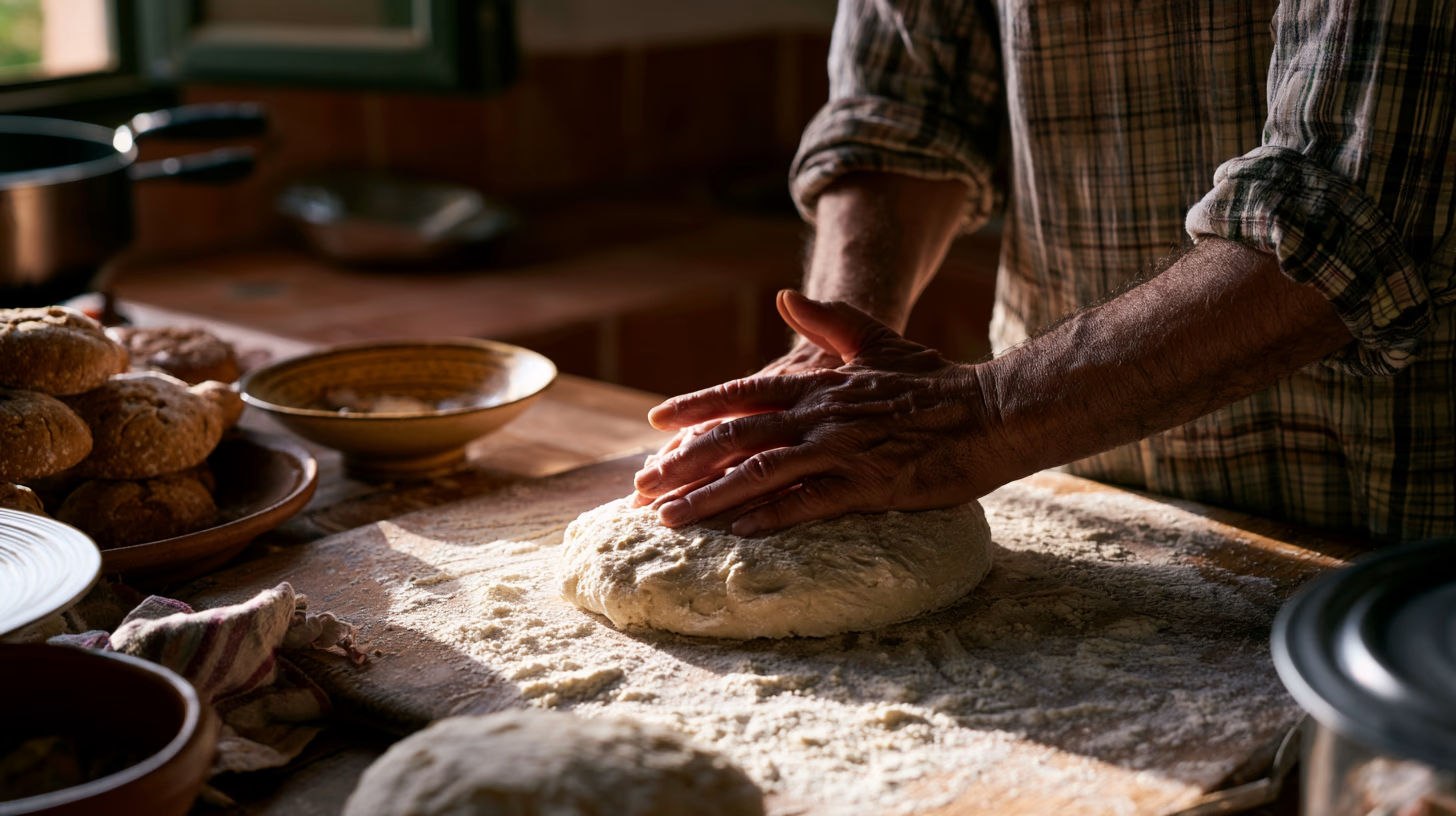
- Add the olive oil and warm water. Mix until a shaggy dough forms, then turn out onto a lightly floured surface and knead for 8–10 minutes until smooth and elastic. The dough should be soft but not sticky — add a little more water or flour a tablespoon at a time if needed.
- Form the dough into a ball, return it to the bowl, cover with a damp cloth and leave to rest for 10 minutes. This relaxes the gluten and makes shaping easier.
- Divide the dough into two equal pieces. Shape each into a smooth ball, then flatten gently with your palm into a round disc about 20 cm across and 1.5–2 cm thick. Place on a baking sheet lined with parchment paper.
- Scatter the sesame and anise seeds over the surface and press them in lightly with your fingertips. If you would like to mark the bread in the Moroccan tradition, press a pattern into the centre now with a fork or skewer.
- Cover loosely and leave to prove for 45 minutes to 1 hour, until the rounds have puffed visibly and feel airy when you press them gently.
- Preheat your oven to 200 °C (fan 180 °C). Bake for 20–25 minutes until deep golden and the base sounds hollow when tapped. Leave to cool on a wire rack for at least 10 minutes before tearing into.
Tips & notes
- No oven? The same dough works beautifully in a dry cast-iron pan or heavy frying pan over medium-low heat — about 12–15 minutes per side, covered with a lid for the first half. This is the original home method and produces a slightly denser, more rustic bread.
- For a richer flavour, prove the dough overnight in the fridge after step 3. Bring back to room temperature before shaping.
- The bread is best eaten the day it is made — torn while still warm. It also freezes very well; wrap each round tightly and reheat directly in a medium oven for 10 minutes.
- Khobz is designed for tearing, not slicing. Tear it at the table, not in the kitchen.
- A bowl of good olive oil or argan oil alongside is not a garnish. It is part of the bread.
- Serve alongside harira — the combination is one of the great, unremarkable everyday meals of Morocco.
The traditional method — khmira
For those who want the bread as it was made before commercial yeast arrived. Slower. More alive. Worth the wait.
What you need instead
- · 100 g Active sourdough starter fed and bubbly, at peak activity
- · 180 ml Warm water slightly less than the yeast version, as the starter adds moisture
- · All other ingredients remain the same — omit the instant yeast and sugar
How it differs
- 1 Mix the flour, semolina and salt. Add the starter and water, then knead for 10 minutes — the dough will feel slightly more alive and extensible than a yeasted dough.
- 2 Cover and leave to bulk ferment at room temperature for 3–5 hours, until noticeably puffy. In summer this may be faster; in a cool kitchen, slower. Trust the dough, not the clock.
- 3 Shape, seed and mark as normal. Leave for a final prove of 1–2 hours, or refrigerate overnight and bake cold from the fridge in the morning.
- 4 Bake as above. The crust will be slightly deeper in colour; the crumb more open, more complex. Before you put the next batch together, pinch off a walnut-sized piece of dough and keep it in a small covered bowl. That is your khmira for next time.
How it is eaten
With harira. Always with harira.
There is no canonical pairing in Moroccan food more fundamental than khobz and harira. The soup exists, in part, to have something to dip the bread into. The bread exists, in part, to make the soup a meal.
During Ramadan, harira is the soup that breaks the fast at iftar — and khobz is always beside it, always warm, always torn rather than cut. Across the rest of the year it appears at breakfast, at lunch, at late-night tables in medina cafés where it costs almost nothing and fills you completely.
“The bread doesn’t accompany the meal. It is the meal. Everything else is just a reason to eat more bread.”
Beyond harira, khobz is the vehicle for almost everything. Olive oil and preserved lemon. A bowl of bissara — the fava bean soup of northern Morocco. Kefta straight from the grill. Amlou, the Amazigh paste of argan oil, almonds and honey that tastes like nothing else on earth and is eaten, naturally, spread thick on fresh bread.
What you will notice, when you eat khobz the Moroccan way, is that the bread is never to the side of the plate. It is at the centre. It is torn and used directly — no knife, no butter dish, no separate bread plate. The bread is the utensil. The bread is the table manners. The bread is the whole point.
Make it. Tear it. Share it. That is all the instruction you need. 🌾
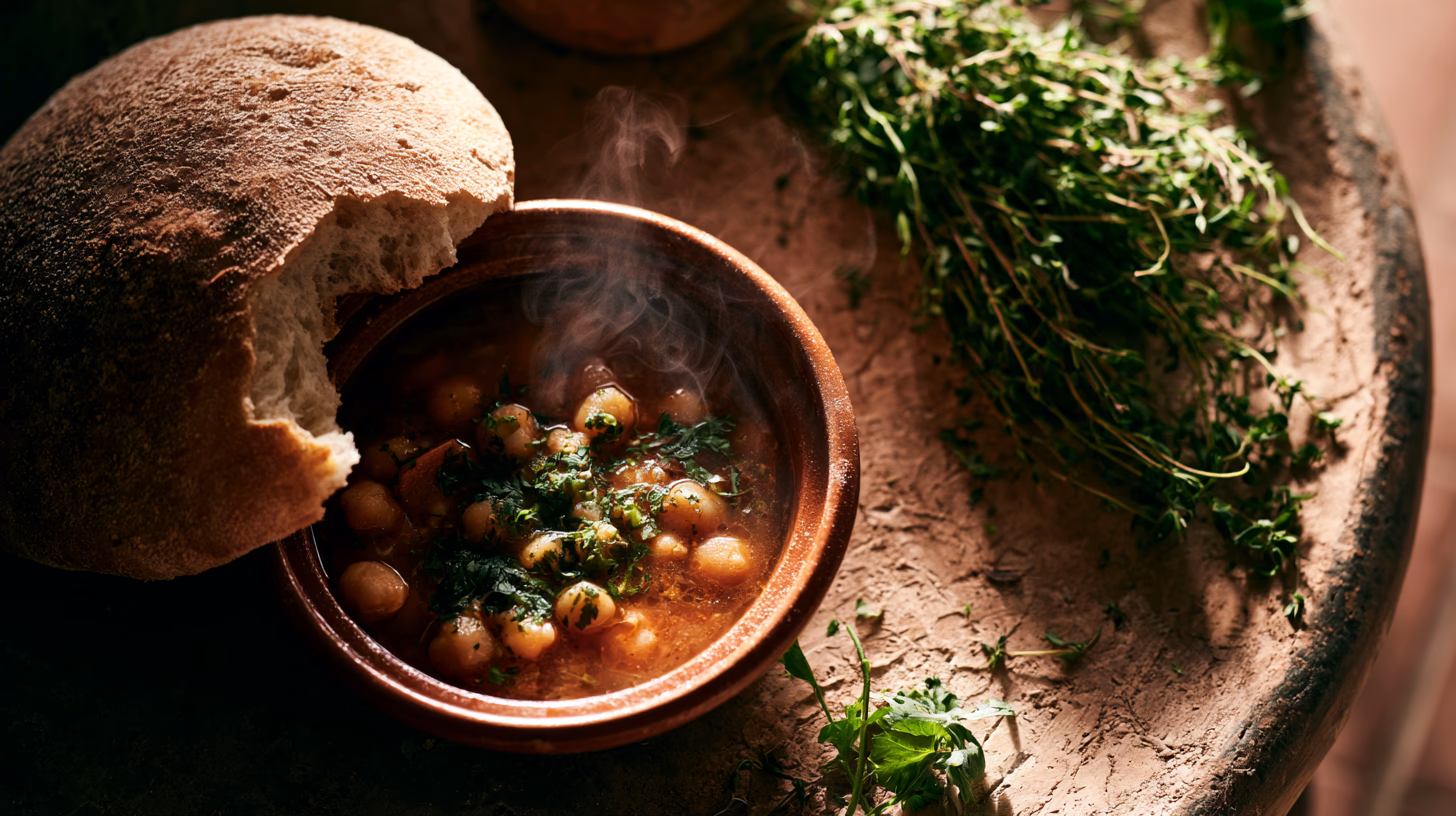
There is nothing remarkable about khobz. That is exactly the point.
It is not a special-occasion bread. It is not a heritage recipe preserved for the sake of preservation. It is the bread that appears every day, on every table, without being asked for — because its absence would be noticed immediately and its presence is taken entirely for granted.
That kind of ordinary is rarer than it looks. Every choice is a vote for the world you want to live in. Sometimes that vote is a round of bread, still warm, placed at the centre of the table. 🌾