Msemen —
the bread of slow mornings
Layered, buttery, made by hand. The Moroccan flatbread that turns breakfast into a ritual.
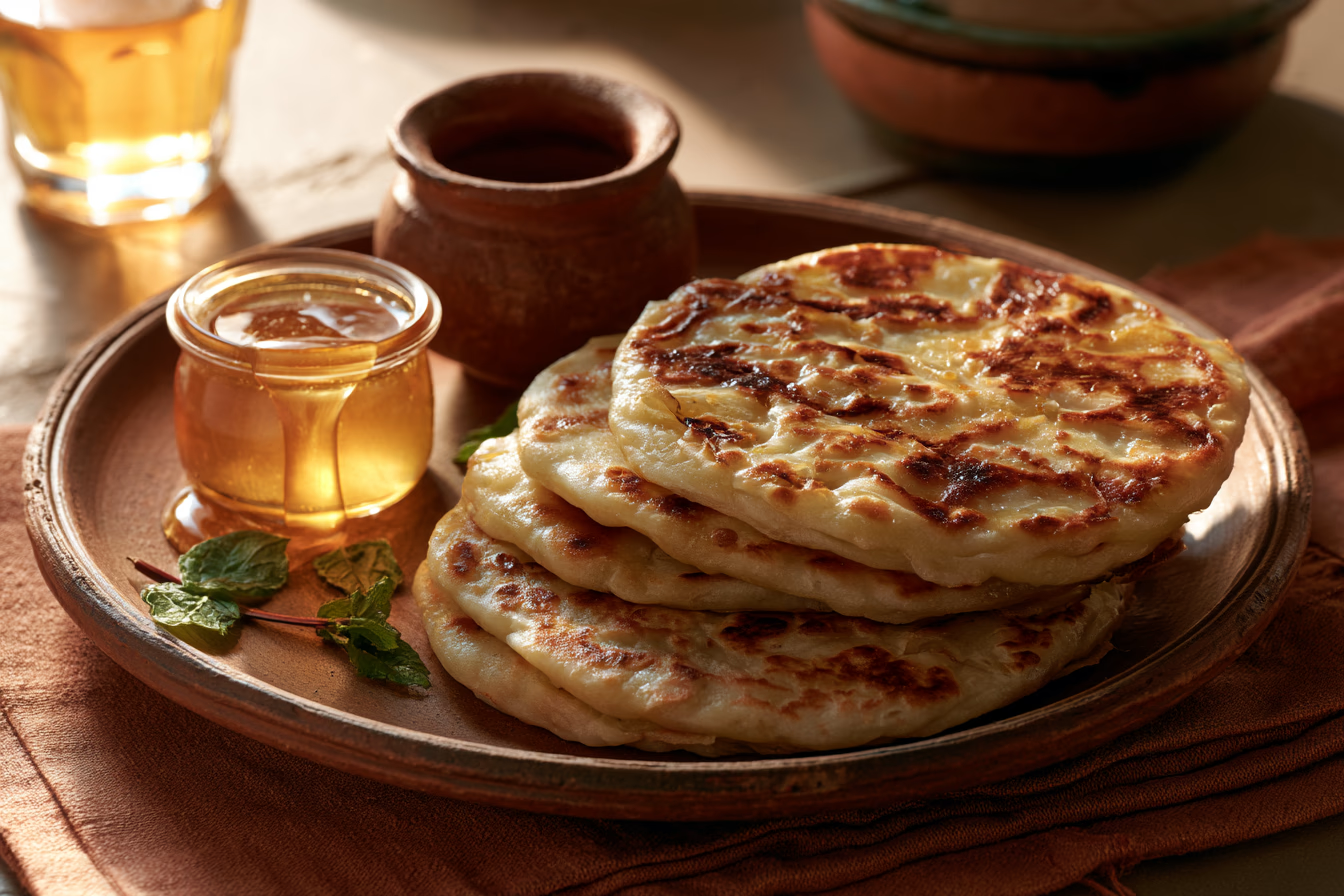
In Morocco, breakfast is not something you rush. It is something you sit down for. A pot of mint tea, a dish of honey, a bowl of argan oil — and Msemen, still warm from the pan, pulled apart by hand at the table.
Msemen is a square flatbread, layered and flaky, made from a simple dough folded many times over with butter and semolina. The folding is everything. It is what gives Msemen its characteristic layers — thin and crisp on the outside, soft and yielding within.
It takes patience. It rewards it generously.
Msemen — Moroccan Layered Flatbread
Ingredients — dough
- 300g Plain flour
- 100g Fine semolina
- 1 tsp Sea salt
- 1 tsp Sugar
- 7g Instant yeast
- 200ml Warm water
Ingredients — for folding
- 80g Unsalted butter, softened
- 4 tbsp Fine semolina
- 2 tbsp Neutral oil (for hands)
Method
- Combine the flour, semolina, salt, sugar and yeast in a large bowl. Add the warm water gradually and mix until a soft, slightly sticky dough forms. Knead for 10 minutes until smooth and elastic.
- Divide the dough into 8 equal balls. Oil your hands and the work surface generously. Cover the balls with a clean cloth and rest for 20 minutes.
- Oil your hands again. Take one ball and press it flat with your palm into a thin round, as thin as you can without tearing — roughly 20cm across.
- Spread a thin layer of softened butter across the surface. Sprinkle lightly with semolina. Fold the left third inward, then the right third over it — like a letter. You now have a rectangle.
- Fold the top third down and the bottom third up — you now have a small square. Set aside and repeat with the remaining balls. Rest for another 10 minutes.
- Take each square and gently flatten again with oiled hands into a larger square, roughly 15cm across. Be gentle — you want to keep the layers.
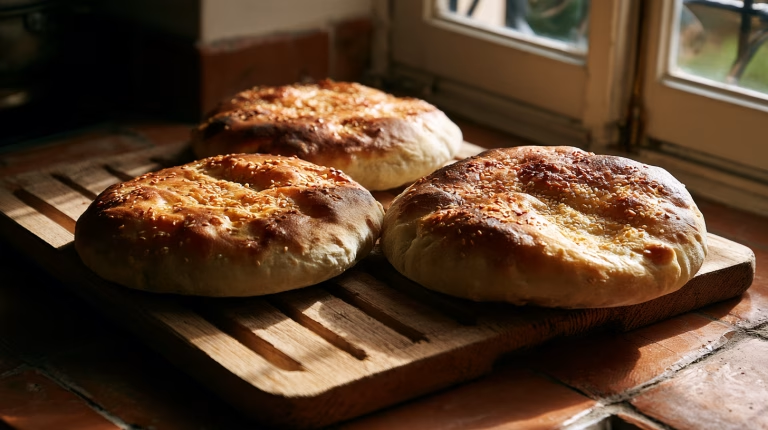
- Heat a dry pan over medium heat. Cook each Msemen for 3–4 minutes per side until golden, with some deeper brown spots. The layers should be visible at the edges.
- Serve immediately with mint tea, honey and argan oil — or with butter and jam for a simpler morning.
Tips & notes
- The dough should be soft and slightly tacky — don’t add too much flour or the layers won’t form properly.
- Oil is your friend here. Keep your hands and surface well oiled throughout.
- Don’t rush the folding — the layers are the whole point of Msemen.
- Msemen is best eaten immediately, straight from the pan.
- Leftover Msemen can be reheated in a dry pan for 1–2 minutes per side.
- For a savoury version, add finely chopped onion, parsley and a pinch of cumin to the filling before folding.
- Wonderful served alongside a bowl of Harira for a full Moroccan breakfast.
Origin
Bread folded with patience
Msemen is eaten across Morocco and much of North Africa — known by different names in different places, but always made by the same patient hands. In Algeria it is called Meloui when rolled into a spiral. In Tunisia, a similar bread appears at every breakfast table. The technique is ancient and simple: fold fat into dough, repeat, cook on a dry pan.
In Morocco, Msemen belongs to the morning. It is what you make when there is time — when the tea is brewing slowly and the day has not yet started. It is eaten with honey that drips through the layers, with argan oil that soaks in gently, with butter that melts on contact with the warm bread.
“The layers are a record of the hands that made it. You can always tell when someone made it with care.”
There is something meditative about the folding. Each square of dough passes through the same motions — press, spread, fold, fold again. It is slow work. Unhurried work. Exactly the kind of cooking Terra believes in.
Terra discovered the art of Moroccan bread-making during her time in the souks and kitchens of Marrakech. Learn more about Msemen’s history and regional variations.
Msemen is not a recipe you make once and forget. It is one you return to — on slow Sunday mornings, on days when you need to use your hands, on mornings when the world outside can wait a little longer.
Make a full batch. Share it warm. And take your time with the folding — that’s where all the magic lives.