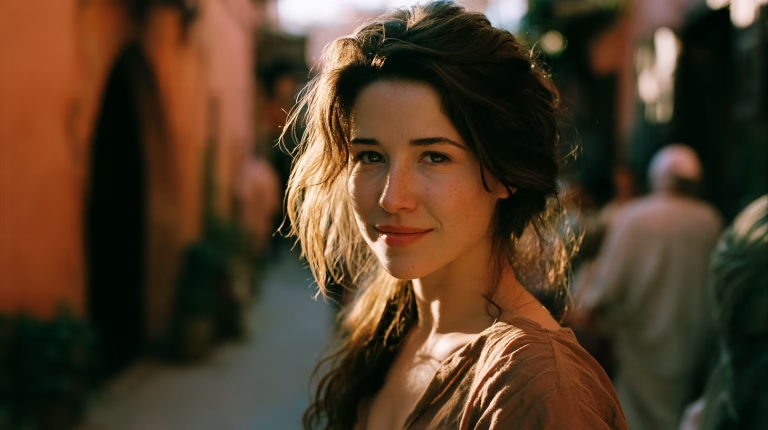
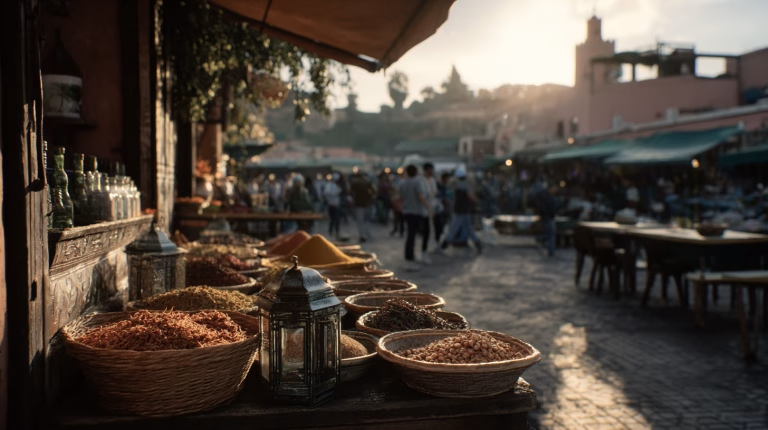
A story from Marrakech — told by Sacha Kay
The best tagine Marrakech has to offer is not found on any map.
You won’t find it on Google. You won’t find it in any guidebook, any food blog, any curated list of hidden gems that isn’t actually hidden at all. You find it only if someone sends you — and even then, you have to knock three times and wait.
Terra has knocked three times. She waits.
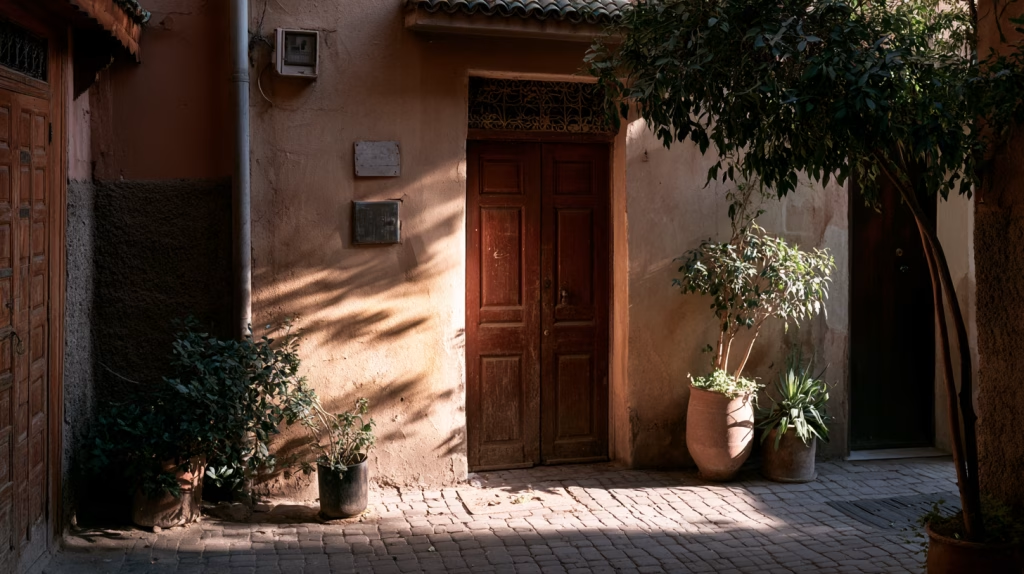
The door is the colour of old rust, set into a wall the colour of the city itself — that particular shade of ochre that Marrakech seems to exhale rather than wear, as if the city is alive and breathing its history into the air. There are no windows facing the street. No sound from inside. Just the smell, faint but unmistakable, drifting through the gap beneath the door: cumin, something sweet she can’t name, and something else entirely. Time, maybe. The particular smell of a kitchen that has been cooking the same things for so long that the walls themselves have learned the recipes.
The door opens.
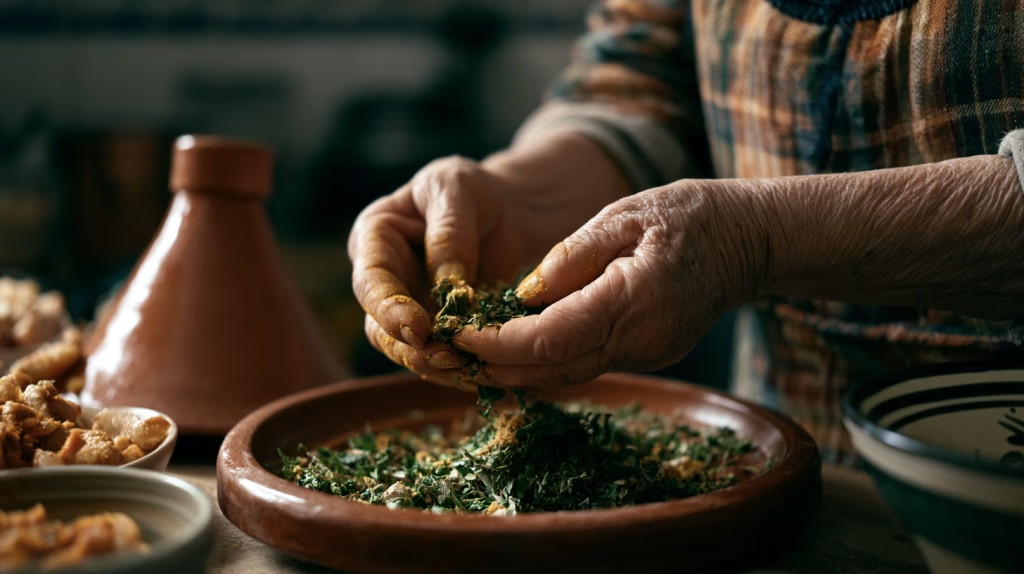
Her name is Khadija. She is somewhere between sixty and ancient — the kind of woman whose age has stopped being relevant because she has become something beyond it. She looks at Terra the way you might eye a guest who arrived early — expected, but not yet welcome. Her hands are extraordinary: mapped with lines, stained faintly yellow at the fingertips from decades of saffron and turmeric, as if time itself had left its fingerprint on her skin. They move constantly, even when the rest of her is still. Hands that have never forgotten what they know.
“You want the recipe,” she says. Not a question. She has already turned back toward the kitchen.
“Yes,” says Terra.
“I won’t give it to you.”
Terra follows her inside anyway.
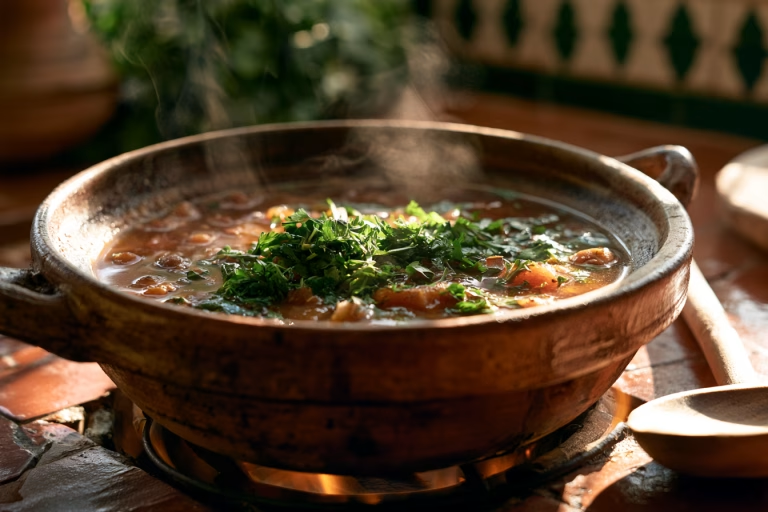
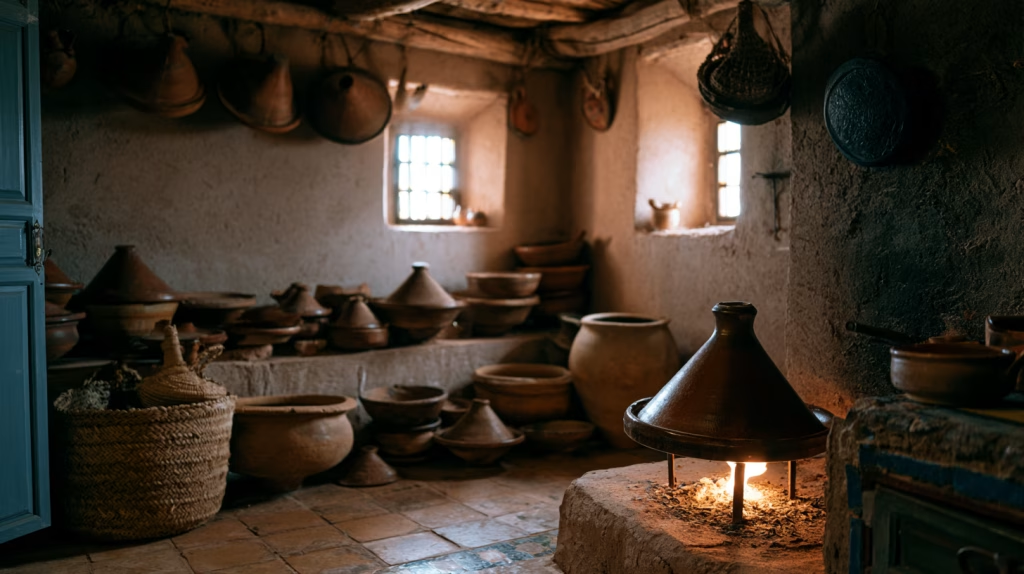
The kitchen is a single room at the back of the house, low-ceilinged and warm, lit by two small windows and the glow of a gas flame. There are clay pots everywhere — stacked against one wall, hanging from a beam, sitting in various stages of use on the stove and the floor. The tagine on the fire is the size of a small planet. Something inside it gurgles like a secret being shared — a sound like contentment, like something that has been waiting patiently to become what it was always meant to be.
Khadija moves through the space the way water moves through a familiar riverbed — without thinking, without looking, knowing every stone by feel. She lifts a lid. She adds something from a jar that Terra can’t identify. She stirs once, clockwise, and replaces the lid.
There is no timer. No recipe card. No phone propped against the backsplash showing a YouTube tutorial. Just a woman and her pots and a lifetime of paying attention.
“Sit,” she says.
Terra sits on a low wooden stool and watches.
“Why won’t you give it to me?” Terra asks.
Khadija doesn’t answer. Instead, she turns to the cabinet, her fingers hovering over the jars as if choosing a word from a silent language. She selects a handful of something dried — herbs, maybe, or petals — and crumbles them between her palms over the pot. The scent blooms like a question neither of them needs to ask.
“Because you would write it down,” she says finally.
“Yes.”
“And then it would become a thing that can be written down.” She says this as if it explains everything.
Perhaps it does.
Terra thinks about this for a long time. She is still thinking about it when Khadija places a bowl in front of her.
Lamb. Prunes. Preserved lemon. And that unnamed sweetness — a depth not from any single ingredient, but from all of them, from the pot, from the flame, from forty years of hands turning the same dish in the same room until it became a memory.
She eats slowly.
Not because she is trying to be mindful. Not because she has read somewhere that eating slowly is good for you. But because stopping feels impossible — because every mouthful is asking her a question she wants to stay inside long enough to understand.
Khadija sits across from her and drinks tea and says nothing.
Outside, Marrakech goes about its business. A meal is ordered on an app. Lunch is eaten at a desk, untasted. A label is read in a supermarket aisle — and nothing is felt.
In here, none of that exists. In here, there is only the food and the woman who made it and the silence between them which is not empty but full — like the tagine itself, like a life lived with attention.
“My mother taught me,” Khadija says eventually. “Her mother taught her. Her mother before that.”
“Did any of them write it down?”
“No.”
“Weren’t they afraid it would be lost?”
Khadija looks at Terra with something that might be amusement, might be pity, might be both.
“It cannot be lost,” she says. “It lives in the hands. You cannot lose what lives in the hands.”
What Khadija describes has a name, even if she would never use it. Intangible cultural heritage — the UNESCO term for exactly this: knowledge, skills and traditions that live not in objects or buildings, but in people. In gestures. In the particular way a hand stirs a pot clockwise, or crumbles dried petals over a flame. Things that cannot be museumified. Things that only survive by being practised.
Khadija has been practising for a lifetime.
Terra asks, later, if she can at least write down the ingredients. Not the method — just the list.
Khadija thinks about this.
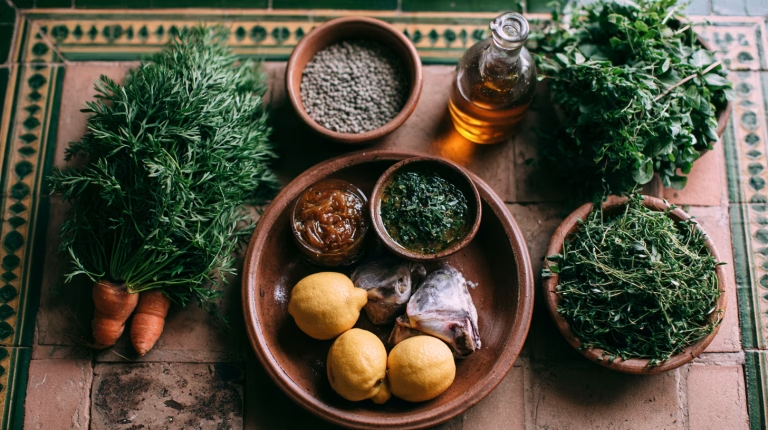
“Lamb,” she says. “Onion. Preserved lemon. Prunes. Saffron from Taliouine — the colour of a sunset that has long since faded from the sky but lingers in the earth. Ras el hanout — the head of the shop, a blend as unique as the spice merchant who mixes it, never the same twice. Olive oil.” She pauses. “Time enough for the spices to forget they were ever separate.”
“That’s it?”
“That’s everything.”
Terra writes it down. She looks at the list. It tells her nothing and everything simultaneously — a map of a place she has never been and cannot reach by following directions.
“Even with this,” she says, “I couldn’t make what you made.”
“No,” says Khadija, without cruelty. “Not yet.”
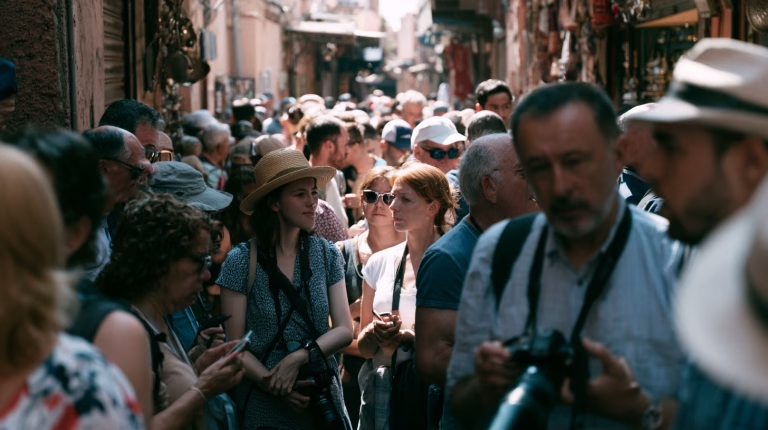
Walking back through the medina an hour later, Terra passes the spice vendors of Rahba Kedima — the same square she had wandered through on her first day, the same smells, the same afternoon light turning everything gold. She stops at the stall where she bought her saffron. The vendor recognises her.
“You came back,” he says.
“I’m still learning,” she says.
He nods as if this is the correct answer.
Perhaps it is.
She never publishes the ingredient list.
♫ The song that lives in the hands
A French chanson with North African soul — born from Khadija’s kitchen, written for everything that cannot be written down.
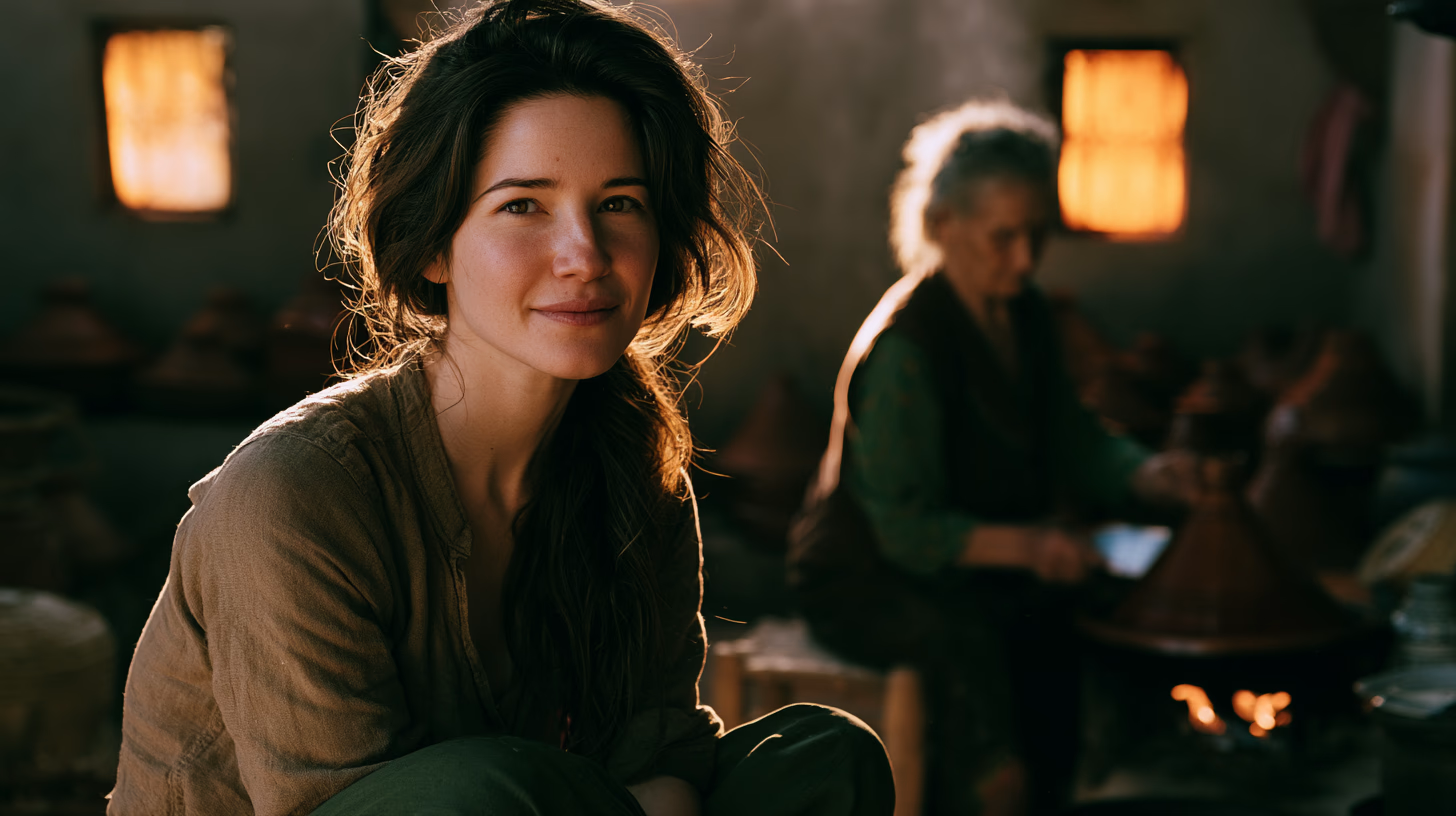
Ce Qui Vit Dans les Mains
Terra Lande · Marrakech
Not because Khadija asked her not to — she didn’t. But because Terra understands, walking home through those narrow streets with the smell of the tagine still somewhere in her clothes, that some things resist being turned into content. Some knowledge is not information. Some recipes are not instructions but relationships — between a cook and her ingredients, between a woman and her mother’s hands, between a kitchen and the years of mornings that have made it what it is.
We have built a world where everything can be searched, saved and delivered in thirty minutes. Where cooking has become a task on a list — somewhere between “pick up dry cleaning” and “reply to emails.” Where the question we ask about food is no longer what does this mean but how long will it take.
Makla — food — is not logistics. It is not fuel. It is the oldest act of care we know. It is how we say I was thinking of you without words. It is how cultures remember who they are. It is how a mother passes something to her daughter that cannot be written down, cannot be googled, cannot be delivered to your door.
It lives in the hands.
And the only way to find it is to start. Not perfectly. Not with the right pot or the right spices or forty years of practice. Just start — with what you have, with someone you love, with enough time to let the spices forget they were ever separate.
Cook something. From scratch. Tonight.
Not because you have to. Because you can. Because your hands, too, are capable of remembering.
This story is the exception — the only way to write down what must be lived.